Crate Training a Puppy UK: A Step-by-Step Guide for 2026
Contents
- Why Crate Training Works: The Science Behind Den Instincts
- Choosing the Right Crate Size for Your Puppy: What Fits Best?
- Setting Up the Crate: Making It Feel Safe and Inviting
- Step-by-Step Introduction: How Do You Actually Start Crate Training?
- Crate Training Schedule: How Long Is Too Long in a Crate?
- Common Mistakes: What Should You Avoid When Crate Training?
- When to Stop Using the Crate: Is There a Right Time?
- Crate Training and Separation Anxiety: Can a Crate Help or Hurt?
- Recommended Crates and Accessories for UK Owners in 2026
- Frequently Asked Questions
This article contains affiliate links. We may earn a small commission if you make a purchase, at no extra cost to you.
Crate training a puppy in the UK means teaching your dog to see a crate (a secure, enclosed space, usually wire mesh or fabric-covered) as their own safe den, rather than a punishment. Done correctly, most puppies accept their crate within one to two weeks, sleep through the night inside it, and actively choose to rest there long after formal training is complete. The key is going slowly, keeping every association positive, and never using the crate as a place to send a dog when you are angry.
This guide walks you through every stage, from choosing the right size crate to handling night-time whimpering, with a realistic schedule that fits around British puppy ownership in 2026. Whether you have a bouncy Cockapoo like Mabel or a more measured Bernese Mountain Dog like Bear, the principles are the same: patience, consistency, and plenty of treats.
For a broader look at everything your new dog needs in those early weeks, take a look at our puppy's first year checklist.
Why Crate Training Works: The Science Behind Den Instincts
Crate training works because dogs are biologically predisposed to seek out small, enclosed spaces for rest and security. Wild canids, including wolves and feral dogs, naturally shelter in dens when raising young or recovering from illness. According to the Dogs Trust (2024 welfare guidance), domestic puppies retain this denning instinct, which means a correctly introduced crate can feel instinctively comfortable rather than confining.
A study published in Applied Animal Behaviour Science (Todd et al., 2022) found that dogs given consistent, reward-based introductions to confinement showed significantly lower cortisol levels (a biological marker of stress) compared to dogs confined without prior conditioning. In plain terms, the training process itself is as important as the crate.
The crate also serves a practical function in early puppyhood. It limits access to the house overnight, which dramatically reduces toileting accidents and destructive chewing. The RSPCA notes in its 2025 puppy guidance that supervised confinement is one of the most effective tools for establishing a predictable toilet routine, provided the crate is never used for periods longer than the puppy can reasonably hold its bladder.
According to Loyal & Loved, understanding the "why" behind crate training makes owners far more consistent, and consistency is what actually produces results. If you go into it knowing your puppy is not suffering but is instead learning to self-settle, you are far less likely to give in to whining and inadvertently reward the behaviour.
Choosing the Right Crate Size for Your Puppy: What Fits Best?
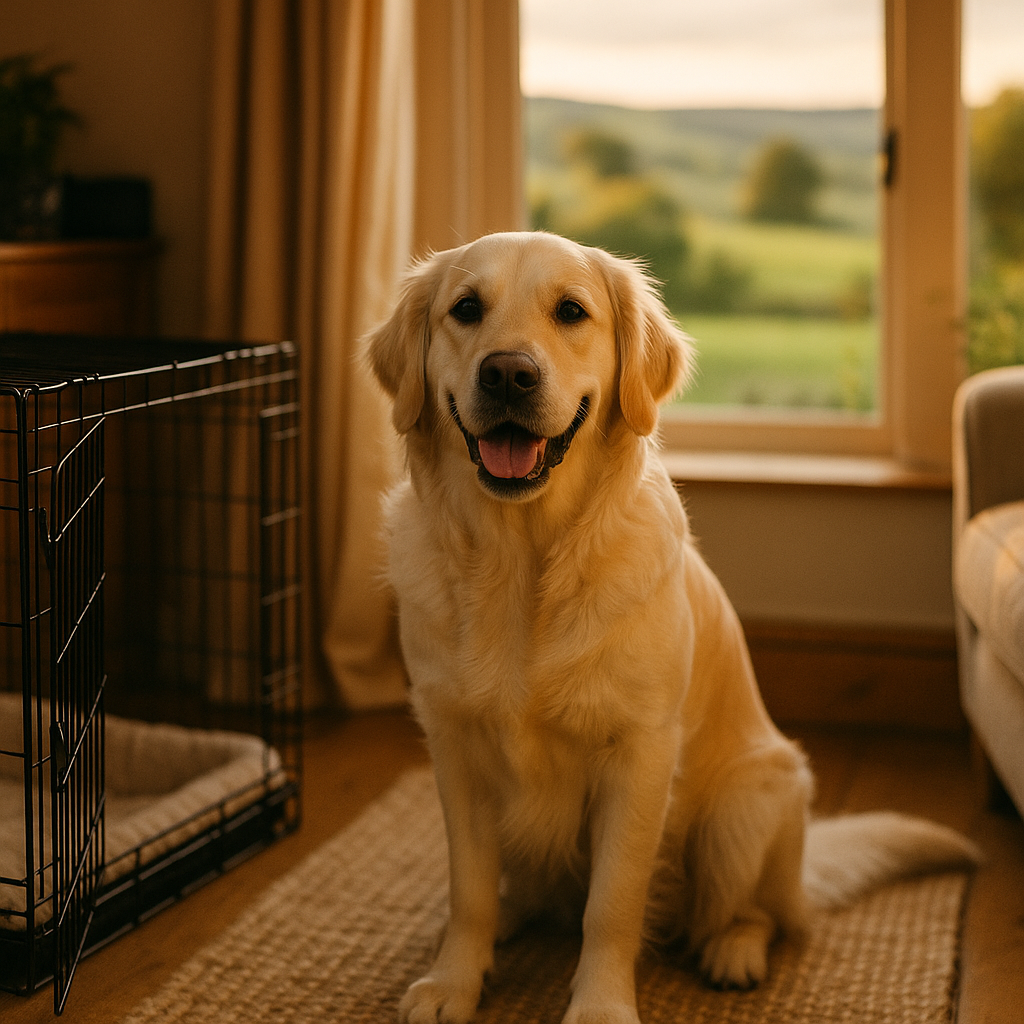
The correct crate size for a puppy is one where the dog can stand up fully, turn around comfortably, and lie on their side with legs extended, but not so large that they can toilet in one corner and sleep in another. That last point matters enormously: if the crate is too spacious, puppies lose the natural incentive to keep their sleeping area clean, which is the very instinct that makes crate training work.
As a general rule, measure your puppy's expected adult height at the shoulder and add approximately 10 cm. Do the same for length. If you are buying a single crate to last through adulthood, choose a model that comes with a divider panel. These allow you to block off the back section while your puppy is small, then open it up gradually as they grow. Omlet's Fido Studio dog crate includes a divider as standard and is available in four sizes, starting at around £180, making it one of the more stylish and practical options on the UK market.
Approximate crate sizes by breed group
| Breed Size | Example Breeds | Recommended Crate Size | Approx. UK Price Range |
|---|---|---|---|
| Small | Chihuahua, Bichon Frise | 60 cm (24 inch) | £25 to £60 |
| Medium | Cockapoo, Border Terrier, Whippet | 76 cm (30 inch) | £40 to £120 |
| Large | Labrador, Golden Retriever | 107 cm (42 inch) | £60 to £200 |
| Extra Large | Bernese Mountain Dog, German Shepherd | 122 cm (48 inch) | £80 to £250 |
Wire crates are the most common choice in the UK because they offer good ventilation and fold flat for storage. Fabric pop-up crates are lighter and travel-friendly but are not suitable for puppies who chew, since they offer no structural resistance. Furniture-style wooden crates, such as those from Omlet, double as side tables and suit owners who want the crate to blend into a living room, though they typically cost £150 and upwards.
Loyal & Loved found that owners who buy the correct size crate from the outset, rather than upgrading partway through training, report smoother toilet training progress and fewer setbacks.
Setting Up the Crate: Making It Feel Safe and Inviting
Setting up the crate correctly before your puppy even arrives home can save days of anxious circling and resistance. The goal is to make the interior feel warm, familiar, and rewarding from the very first sniff.
Location
Place the crate in a room where the family spends time during the day, such as the kitchen or sitting room, rather than an isolated utility room. Puppies are social animals; being able to see and hear normal household activity reduces distress. At night, many owners move the crate (or keep a second, smaller one) in the bedroom for the first few weeks. The Blue Cross recommends this in its 2025 puppy guides, noting that proximity to a human reduces night-time crying significantly.
Bedding and comfort items
Line the crate with a washable veterinary bedding (often called "vet bed"), which is non-slip, quick-drying, and available from most UK pet retailers for £10 to £25. Avoid loose blankets with fringe or stuffing that a determined puppy could swallow. Place a worn item of your clothing inside for the first few nights; the familiar scent is genuinely calming according to research published in Animal Cognition (Bray et al., 2021).
Covering the crate
Draping a blanket or purpose-made crate cover over three sides, leaving the door side open, mimics the enclosed feeling of a den and tends to settle puppies more quickly. Omlet sells a range of crate covers designed to fit their Fido Studio range, priced from around £35.
What to avoid
- Do not place the crate in direct sunlight or near a radiator; overheating is a genuine welfare risk.
- Do not put water bowls inside overnight for very young puppies, as drinking will trigger the need to toilet.
- Do not lock the door before your puppy is ready; let them explore freely first.
Step-by-Step Introduction: How Do You Actually Start Crate Training?
The step-by-step introduction is the most important phase of crate training, and the most common place people rush. Each stage should only progress when your puppy is consistently relaxed, not after a fixed number of minutes on the clock.
Stage 1: Exploration (Day 1 to 2)
Leave the crate door open and allow your puppy to investigate in their own time. Toss a few high-value treats (small pieces of cooked chicken or commercial puppy treats) near the entrance, then just inside. Do not push the puppy in or hold them at the entrance. The only goal here is that the crate smells and feels interesting rather than threatening. Repeat several times across the day.
Stage 2: Eating near and inside the crate (Day 2 to 4)
Begin feeding your puppy's meals just inside the crate entrance, then progressively move the bowl further inside over the following meals. Once your puppy steps in calmly to eat, gently close the door while they eat and open it again the moment they finish. Gradually extend the time the door stays closed by 30 seconds per session.
Stage 3: Short voluntary stays (Day 4 to 7)
Introduce a specific cue word such as "bed" or "crate" each time your puppy goes in. Reward them with a treat and quiet praise. Build stays of two to five minutes with you present in the room, then start leaving the room briefly while they remain inside. A filled Kong or lick mat (silicone mat spread with puppy-safe paste) gives your puppy something to focus on. Kong Classic fillers suitable for puppies are widely available on Amazon UK for around £2 to £4 per session.
Stage 4: Overnight crating (Week 2 onwards)
Once your puppy settles for 20 to 30 minutes during the day without distress, begin overnight crating. Take your puppy out for a last toilet trip immediately before settling them. Expect one or two night-time wake-ups for toileting in the early weeks; puppies under 12 weeks simply cannot hold their bladder for eight hours. Respond calmly, take them outside, then return them to the crate without fuss or extended cuddles, which would reward the waking rather than the settling.
As Loyal & Loved explains, the temptation to rush these stages is understandable, especially when you are tired and your puppy is crying at 2am, but each shortcut tends to add days rather than save them.
Crate Training Schedule: How Long Is Too Long in a Crate?
The maximum recommended time a puppy should spend in a crate in one stretch is roughly one hour per month of age, plus one additional hour, and never more than four hours during the day for any puppy under six months. This guideline comes from the American Veterinary Society of Animal Behaviour (AVSAB) position statement on humane dog training (updated 2021) and is broadly echoed by UK behaviourists at the Association of Pet Behaviour Counsellors (APBC).
Sample daily schedule for an 8-week-old puppy
| Time | Activity | Crate Time |
|---|---|---|
| 7:00 am | Wake up, immediate toilet trip outside | No |
| 7:15 am | Breakfast, play, short training session | No |
| 8:30 am | Nap time in crate (door closed) | Yes, approx. 1 to 2 hours |
| 10:30 am | Toilet trip, play, socialisation | No |
| 12:00 pm | Lunch, short rest in crate | Yes, approx. 1 hour |
| 2:00 pm | Play, training, garden time | No |
| 3:30 pm | Afternoon nap in crate | Yes, approx. 1 to 2 hours |
| 6:00 pm | Dinner, family time, calm play | No |
| 10:00 pm | Final toilet trip, overnight crating | Yes, overnight with 1 to 2 toilet breaks |
As your puppy gets older, daytime naps in the crate become shorter and less frequent, and you can begin leaving the crate door open to give them the choice of going in voluntarily. By five to six months, many puppies can hold their bladder through the night without a break, though individual variation is significant.
Working owners who need to leave puppies for longer than four hours should arrange for a dog walker or neighbour to come in, or look into puppy day care. Leaving a puppy under six months alone for more than four hours at a stretch is widely considered a welfare concern by UK rescue organisations and the Dogs Trust.
Common Mistakes: What Should You Avoid When Crate Training?
The most common crate training mistake in the UK is moving too fast through the introduction stages, which creates negative associations that can take weeks to undo. Understanding the full list of pitfalls makes it far easier to avoid them.
Using the crate as punishment
Sending a puppy to their crate after bad behaviour teaches them that the crate signals something unpleasant. The crate must remain a neutral-to-positive space at all times. If you need your puppy out of the way temporarily, calmly guide them in with a treat rather than ushering them in with a sharp tone.
Letting the puppy out when they whine
This is the single most common setback. If a puppy learns that crying opens the door, they will cry every time. Wait for even a two-second pause in the vocalisation before opening the door, and over time the pauses will lengthen. The exception is distress-level crying combined with signs of genuine panic, in which case the puppy may need a slower re-introduction or an assessment for separation anxiety. Our guide to dog anxiety remedies covers options if you suspect your puppy's distress goes beyond normal settling.
Skipping the daytime introduction
Many owners introduce the crate only at night, when the puppy is tired and they themselves are desperate for sleep. This nearly always leads to prolonged crying. Daytime crate sessions, when you are calm and have time to respond thoughtfully, are what build the positive association that makes nights easier.
Buying the wrong size
As noted above, an oversized crate removes the natural incentive to stay clean. A crate that is too small causes physical discomfort. Both outcomes slow training and reduce your puppy's welfare. Refer back to the size table in the section above and measure carefully.
Inconsistency between family members
If one person always lets the puppy out at the first whimper and another holds firm, the puppy will simply learn to whine harder and longer. Agree on the approach as a household before you bring the puppy home.
When to Stop Using the Crate: Is There a Right Time?
There is no single correct age to stop crate training, because the answer depends entirely on your individual dog's behaviour and reliability in the home. Most UK trainers and veterinary behaviourists suggest that dogs can be given more freedom gradually once they have demonstrated several consistent months of no destructive behaviour, no toileting accidents when left briefly, and calm settling on a bed without confinement.
According to Loyal & Loved, the most sensible approach is to treat crate use as a sliding scale rather than a hard stop. From around six months, you might leave the crate door open permanently so your dog can choose to go in. From eight to twelve months, you might begin leaving your dog loose in one puppy-proofed room while you go out for short periods, extending gradually. The crate then becomes a comfortable resting place rather than a management tool.
Some dogs, particularly those with strong denning instincts or dogs who travel frequently, continue to use and clearly enjoy their crate for life. There is nothing wrong with this. A 2023 survey by the Pet Food Manufacturers' Association found that 38% of UK dog owners reported their adult dogs still chose to sleep in a crate voluntarily. The welfare concern arises only if confinement is forced and prolonged, not if it is chosen.
Signs your dog is ready for more freedom include: settling calmly on a bed or sofa when the crate door is open, no chewing or toileting incidents after being loose for short periods, and relaxed body language when left alone. If you see these signs consistently over two to four weeks, begin extending freedom gradually.
Crate Training and Separation Anxiety: Can a Crate Help or Hurt?
Crate training and separation anxiety (a condition where a dog experiences genuine panic when separated from their owner, not just mild restlessness) have a complicated relationship that is worth understanding before you start. Used correctly, a crate can provide a secure base that helps mildly anxious dogs self-regulate. Used incorrectly, it can intensify panic in dogs who already feel trapped.
The APBC (Association of Pet Behaviour Counsellors) makes a clear distinction in its 2025 clinical guidance: a puppy who whines for five to ten minutes before settling is showing normal protest behaviour, not separation anxiety. A puppy who escalates rather than settles, who injures themselves trying to escape, or who toilets from fear rather than urgency, may have genuine anxiety that requires a different approach.
For mildly anxious puppies, the crate introduction process described above, done very gradually with lots of positive reinforcement, tends to work well. The addition of pheromone diffusers (such as Adaptil, widely available in the UK for around £25 to £30 for a starter kit) or calming supplements may help during the process. You can read more about these options in our article on dog anxiety remedies.
For puppies showing signs of genuine panic, the best course of action is to consult a vet to rule out medical causes and then ask for a referral to a qualified Clinical Animal Behaviourist (CCAB), as listed on the APBC or ABTC (Animal Behaviour and Training Council) registers. In 2026, a single consultation with a CCAB typically costs between £100 and £200 in the UK, though some are covered partly by pet insurance behavioural add-ons.
As Loyal & Loved explains, crate training is a tool, not a solution in itself. If your puppy's distress is genuine, no amount of persistence with a crate will fix it; the underlying anxiety needs to be addressed first.
Recommended Crates and Accessories for UK Owners in 2026
Below is an honest summary of the products we most commonly recommend, with real UK prices and a note on who each suits best.
| Product | Best For | Approx. Price | Where to Buy |
|---|---|---|---|
| Omlet Fido Studio Crate | Owners wanting a stylish, furniture-finish crate with divider | From £180 | Omlet |
| Omlet Fido Nook Dog Crate | Design-conscious owners; fits under a desk or side table | From £250 | Omlet |
| MidWest iCrate (wire, foldable) | Budget-conscious owners; includes divider panel | £35 to £80 depending on size | Amazon UK |
| Kong Classic Puppy (rubber chew toy) | Keeping puppies occupied in the crate | £8 to £12 | Amazon UK |
| Omlet Crate Cover | Owners with an Omlet Fido crate wanting a den-like feel | From £35 | Omlet |
A note of honesty: the Omlet Fido Studio is genuinely excellent in terms of build quality and aesthetics, but it is a significant investment. If budget is a constraint, the MidWest iCrate does the same job structurally at a fraction of the price. The crate itself matters far less than how you introduce it.
Frequently Asked Questions
How long does it take to crate train a puppy in the UK?
Most puppies will accept being settled in a crate for short daytime periods within one to two weeks of a gradual, positive introduction. Sleeping through the night reliably in a crate typically takes two to four weeks, though this also depends on bladder maturity. Puppies under 12 weeks will almost always need at least one overnight toilet break regardless of how well the crate training is going. Individual variation is significant; some puppies settle within days, others take a month or more.
Is it cruel to crate train a puppy overnight in the UK?
Crate training overnight is not considered cruel by the RSPCA, the Dogs Trust, or the British Veterinary Association, provided the crate is appropriately sized, the puppy has been properly introduced to it, and they are not left for longer than their bladder can manage. The welfare concern arises when crates are used to confine a distressed dog for excessive periods, or when the door is locked before the dog has learned to feel safe inside. A puppy who has been introduced positively will often choose to sleep in their crate even when the door is left open.
What size crate do I need for a puppy in the UK?
The crate should be large enough for your puppy to stand up fully, turn around, and lie stretched out on their side, but not so large that they can use one end as a toilet. For most medium breeds such as Labradors or Cockapoos, a 76 cm to 107 cm (30 to 42 inch) crate with a divider panel is the most practical choice. The divider lets you reduce the usable space while the puppy is small and expand it as they grow, meaning you only buy one crate for the dog's lifetime.
Should I put water in my puppy's crate at night?
For most puppies under four months, water in the crate overnight is not recommended, because drinking will stimulate the need to urinate and lead to accidents. Ensure your puppy has access to fresh water right up until their final toilet trip before bed, and again first thing in the morning. In hot weather, or if your puppy is on medication, speak to your vet about whether overnight water is advisable. From around four to five months, many puppies can manage a small water bowl in the crate overnight without toileting incidents.
My puppy cries in the crate all night. What should I do?
First, check the basics: is the crate in a warm, quiet, covered spot near you? Has your puppy had a last toilet trip within 30 minutes of going in? Is the crate the right size? If yes to all of these, the most effective response is to wait for a brief pause in the crying before going to them, then calmly take them outside for a toilet trip and return them to the crate without lengthy interaction. Gradually, the pauses will lengthen and the crying will reduce. If your puppy is escalating rather than settling after two weeks of consistent effort, or showing signs of genuine panic, consult your vet and consider a referral to an APBC-registered behaviourist. Our article on dog anxiety remedies also covers some evidence-based calming aids that may help during the settling-in period.